
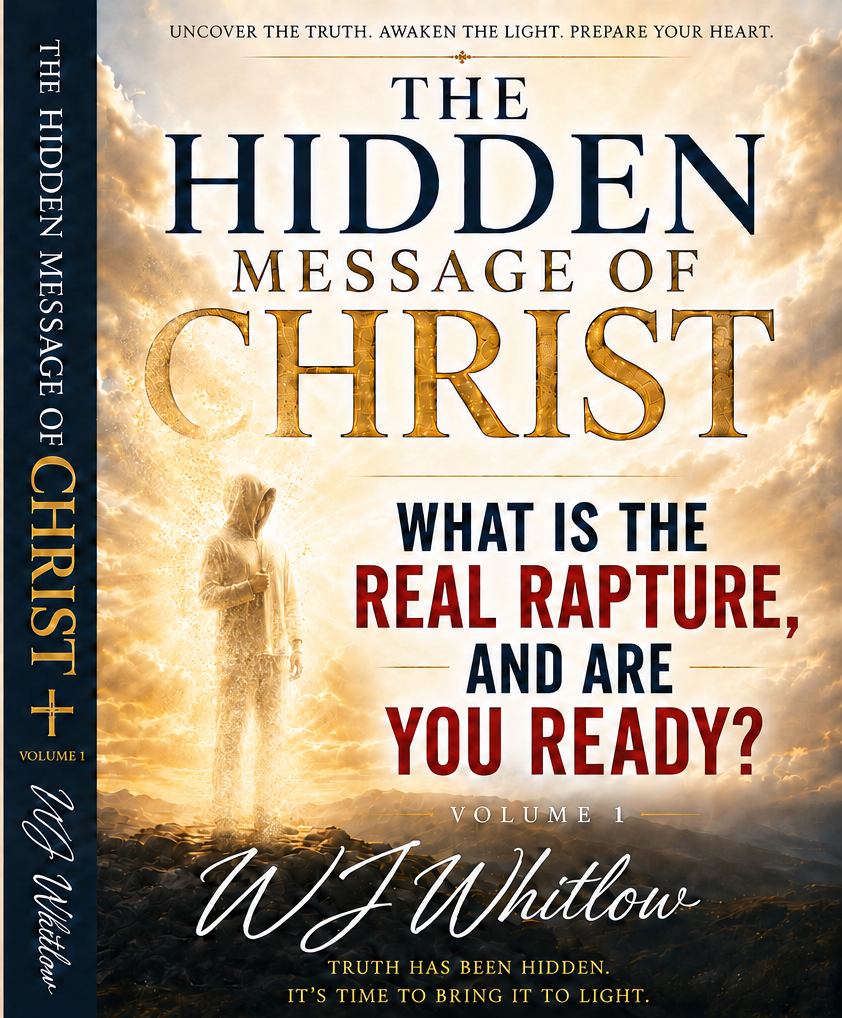
VOLUME 1 · WJ WHITLOW · IMPERATIVE PRESS
The Hidden Message of
Christ
What does it truly mean to be ready? Not ready in the way fear-based religion taught you — watching the sky, hoarding certainty, waiting for an escape that removes all responsibility. Ready in the way that has no terror in it, because the life you are living right now could withstand honest examination.
The Hidden Message of Christ, Volume 1 brings scripture, ancient African wisdom, and unflinching historical honesty into conversation around a single, urgent question. Across 14 chapters, a full workbook, a Heart Weight Assessment, and a 30-Day Preparation Plan, this book offers something more durable than fear: a practice. One that begins today.
The Full Arc of
14 Chapters
Each chapter builds the foundation the next one stands on. Read in order, chapter by chapter — the framework compounds.
CHAPTER 1
The Rapture You Were Sold
How a 19th-century doctrine became indistinguishable from scripture.
CHAPTER 2
Your Heart, Your Judge
The ancient Kemetic wisdom of the weighed heart and the 42 Declarations of Innocence.
CHAPTER 3
The God Inside, Not the God Above
The internal compass that precedes every book, creed, and institution.
CHAPTER 4
The Message Hidden in Plain Sight
What Christ actually taught about fruit, mercy, and the least of these.
CHAPTER 5
All Things Sacred — We Are All Godly
Every person carries the divine image; ownership of God produces division.
CHAPTER 6
When Faith Became a Weapon
The Inquisition, the Crusades, and what ordinary sincerity produced without a living conscience.
CHAPTER 7
Conquest Disguised as Salvation
How religion became the legal and theological engine of colonization.
CHAPTER 8
Bad Company, Lower Self
Meditation, grounding, sunlight, and the people who shape the weight of your heart.
CHAPTER 9
The Bible as Tool, Not Hammer
Scripture as a mirror for self-examination, not a weapon aimed outward.
CHAPTER 10
Grace, Deeds, and the Weighed Heart
Answering the hardest objections honestly and without evasion.
CHAPTER 11
Clear the Instrument
Body, mind, conscience, and the pineal gland as the seat of discernment.
CHAPTER 12
The Universe Doesn't Forgive — It Balances
Consequence as structural, not arbitrary; sowing and reaping at every scale.
CHAPTER 13
Daily Judgment — Practicing for Your Day
The morning intention, the weight check, the evening accounting.
CHAPTER 14
Surviving Isn't Escaping — Becoming Light
Survival as transformation, sustained one honest deed at a time.
Plus: Epilogue · Appendix A: A Timeline of Religion Used as a Tool of Conquest · The Heart Weight Assessment · The Survive The Rapture Workbook · The 30-Day Preparation Plan
INSIDE THIS BOOK
Three Tools for
Real Preparation
The Heart Weight Assessment
A 42-question self-examination instrument across seven categories — Truth, Justice, Relationships, Words, Service, Discipline, and Repair. Score your present practice, identify where your heart is heavy, and track your progress monthly. Not a divine verdict. A mirror.
The Survive The Rapture Workbook
A 14-section guided journal companion — one section per chapter — with guided exercises, journal prompts, and fill-in worksheets. Includes the Personal Negative Confession template, the Company Audit, the Weekly Grounding & Sunlight Tracker, the Daily Accounting Template, and the Becoming Light Page.
The 30-Day Preparation Plan
A structured 4-week implementation guide: Week 1 Foundation, Week 2 Reckoning, Week 3 Purification, Week 4 Integration. Designed for individual study or small-group / Bible study use. Start today — while the ideas are still fresh.
Every tool is included in the ebook — no additional purchase required.
THIS BOOK IS FOR YOU IF...
To Every Soul Who Was Taught to
Fear Their Ending
To every soul who was taught to fear their ending before they were taught to examine their living — this book is for the moment you decided the second was more important than the first.
And to the ancestors whose wisdom was old before empire tried to erase it, and whose patient scale still waits to weigh every heart that comes home.
This book was written for readers who:
- Were raised to watch the sky instead of examine the heart
- Feel a tension between inherited religious fear and a deeper moral instinct
- Want to take the spiritual claims of Christ more seriously — not less — than institutional religion has
- Are ready to face the honest history of religion without losing faith in the message underneath it
- Are tired of waiting for permission to become the person their own conscience has been asking them to be
- Believe judgment is already happening, deed by deed, and want to prepare with intention
You do not need to abandon your faith. You need to take it seriously enough to live it.
COMMON QUESTIONS
The Questions You
May Be Asking
Is this book anti-Christian?
This book does not require readers to convert from one religious institution to another. It brings traditions into conversation around a shared moral question: How is a life prepared for judgment? It is not offered to attack faith itself. The lesson is that faith detached from a living, internal conscience becomes one of the most dangerous tools human beings have ever built for themselves. You are not abandoning Christian tradition by looking inward. You are rejoining one of its oldest, most persistent, and most quietly persecuted currents.Are you saying we earn salvation through good deeds?
No scale, workbook, ritual, or list of good deeds can make a human life flawless. People cause harm through ignorance, fear, weakness, and selfishness. Grace names the truth that human worth and the possibility of transformation are not exhausted by failure. But grace is not permission to avoid accountability. In the New Testament, grace and transformation belong together. James insists that faith without works is dead. The question is not whether a person can purchase salvation with enough good behavior. The question is whether a claimed encounter with grace produces any visible transformation. Deeds do not function as a bribe offered to God. They are evidence of what faith has become in a life.Is this book replacing Christ with Kemetic spirituality?
This book does not require readers to convert from one religious institution to another. The Kemetic weighing of the heart predates Christianity and offers a powerful image of truth, balance, and deed-based accountability. The Gospels offer teachings about fruit, mercy, neighbor-love, inner transformation, and care for the vulnerable. What the parallel proves is that human beings were wrestling with moral accountability long before modern Rapture doctrine appeared. Readers may understand Ma'at as sacred reality, ethical philosophy, ancient religious tradition, or a comparative lens. The practical question remains: Does the comparison help us live more truthfully and justly?Can I still believe in a literal Rapture?
You can retain that belief and still practice everything essential in this book. If Christ returns, truthfulness, mercy, justice, repentance, and love will not make you less ready. If your interpretation changes, those same qualities remain worthy. The book's argument is not that every believer must reach the same conclusion about prophecy. It is that no prophecy should be used to make this life disposable or another human being unworthy of love.Can the internal compass be wrong?
Yes. Human beings rationalize. Desire can disguise itself as guidance. Fear can speak with the voice of certainty. The internal compass is therefore not whatever feeling happens to arise inside us. It is conscience disciplined through truth, humility, reflection, evidence, and accountability. A compass becomes trustworthy through calibration. Community, scripture, history, reason, and honest feedback can all help calibrate it. None should be treated as automatically infallible, including our own interpretation.What about people who do terrible things?
Affirming that every person carries sacred worth does not mean society must tolerate every behavior. Protection of victims is itself a moral duty. Justice may require separation, restraint, exposure, restitution, or punishment. The distinction is between accountability and dehumanization. Accountability says: the harm is real; it must stop; consequences are necessary; repair is owed. Dehumanization says: this person has no remaining human worth, and our cruelty toward them is now righteous. The first protects moral order. The second risks reproducing the very evil it claims to oppose.
More questions? The author's full responses are inside Chapter 10 — Grace, Deeds, and the Weighed Heart.
THE HIDDEN MESSAGE OF CHRIST · VOLUME 1
Are You Ready
For The Rapture?
If Christ returns tomorrow, a life of love, justice, truth, and mercy will not have been wasted. If no trumpet sounds in our lifetime, that same life will still have mattered. Either way, the work is the same. That is where this book begins.
14 chapters. The Heart Weight Assessment. The Survive The Rapture Workbook. The 30-Day Preparation Plan. Everything you need to begin today.
Published by Imperative Press · WJ Whitlow · First Edition